There is a pothole I have driven past for months. I know which lane to take to miss it. I kept meaning to report it and never did, because reporting it felt like more work than swerving around it. Multiply that one small surrender across a city and you have the whole problem.
In Alchemy, Rory Sutherland gives a chapter a title that sounds like a joke until it stops being one. Solving a problem with logic alone, he writes, is like playing golf with one club.
A golfer is allowed fourteen. You carry the driver and the wedge and the putter because the course keeps changing under your feet, and no single swing fits every lie. Reach for one club on every shot and you will look disciplined, you will look logical, and you will lose to anyone who opened the whole bag.
That is the city, and that is 311. Once you see it through the chart Sutherland draws a page later, the 2027 date on Toronto’s plan stops reading like a schedule and starts reading like a confession.
The four boxes
Sutherland’s chart is two lines crossing. Left to right: did the decision fail or succeed. Bottom to top: was the approach logical or imaginative. Four boxes, and he fills each one with what happens to you, the person who made the call.
| If it fails | If it succeeds | |
|---|---|---|
| Imaginative | You look like a fool. You are out. | You get mild credit, and the idea is filed as though it had been the logical plan all along. |
| Logical | You were merely unlucky. You keep your seat. | You keep your seat, and you get the bonus or the promotion. |
Look at the bottom row first. The logical approach is safe in both columns. Win and you are rewarded. Lose and you were unlucky, the budget turned, the scope changed, and you keep your seat. There is no box on the bottom row where anything bad happens to you.
Now the top row. The imaginative approach is exposed in both columns. Lose and you are the fool who bet on something strange. Win and you barely get the credit, because the moment it works everyone decides it was obvious all along.
Sutherland puts the whole thing in one line, and it is the most honest sentence ever written about institutions: it is much easier to be fired for being illogical than for being unimaginative.
Nobody inside a system gets punished for being slow and sensible. They get punished for being fast and strange. So the system selects, every day, for the safe club. That is the one club. Logic. The study, the committee, the phased rollout, the date two years out. Logic keeps the seat safe, and the safe seat keeps choosing logic.
Here is the same chart with the players placed on it.
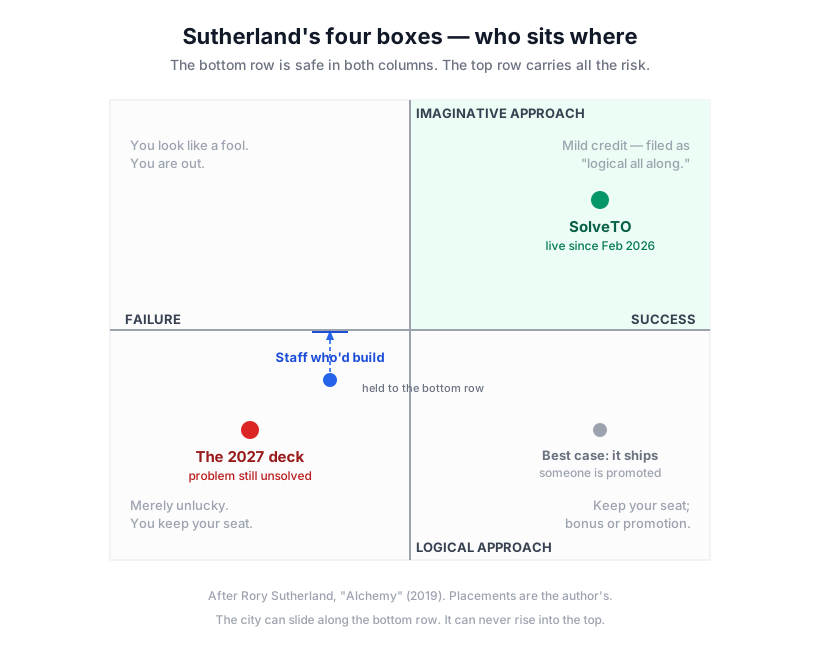
Notice what the city can and cannot do on this chart. It can slide left and right along the bottom row, fail and stay, or succeed and get promoted. It can never rise. The top row is closed to it. Not by ability. By incentive.
Where the city sits, and why
Bottom-left. A careful, logical plan for a problem that is still, today, not solved.
The May 14 deck is a beautiful artifact of the safe club. Two initiatives, a front-end redesign and a thing they named “Closing the Loop.” User research. Usability testing. A phased rollout, division by division. Milestones to the end of 2027. Everything else to be confirmed by division.
Every word of that is the bottom row doing exactly what it is built to do. Watch what happens to the people who made it. If the redesign ships on time, they modernized 311, and they are promoted. If it slips to 2028, or loses a division, or gets rescoped when the budget turns, they were unlucky, and they keep their seats. There is no version of this where being two years slow costs anyone anything.
So the 2027 date is not a deadline the staff are straining against. It is the resting speed of a plan that carries no penalty for being late. A 2027 date in a 2026 deck is not a promise. It is the gravity of the bottom row.
Here is the part I want you to sit with. I do not think the people in that room are lazy or timid. I think a lot of them want to build fast, want to be bold, want to ship the imaginative thing. As of April, Parks requests carry staff-written status notes, which means somebody fought for that inside the machine. So if the will is there, what is holding them in the bottom row?
I do not know, and that is the question this whole essay exists to ask. Is it policy. Is it procurement rules that turn three weeks of work into a three-year process. Is it a security review that no idea survives intact. Is it budget, or a manager, or a layer of managers, or a culture where the chart I just drew is so well understood that nobody bothers reaching up anymore. Something is pinning willing people to the bottom row. I want you to wonder what it is, and what keeps the ceiling where it is.
That is not an accusation. It is a flashlight. Point it wherever the answer is.
Where I sit, and what I did
Top-right. I did not choose the box. It is just where you stand when you build outside the building.
When I shipped SolveTO in February, I was one bad month from the top-left box, the fool who built a thing nobody wanted. That is the real cost of the imaginative club, and it is why almost no one picks it up. If it had flopped, that is where I would be, and you would never have read a word of this.
It did not flop. Hundreds of people. Over 850 reports. Eleven departments. Two cities. Built alone, at night, fixing the thing the same week a report showed me what was broken. So I slid into the top-right instead.
I want to be precise about one thing, because it is the engine of the whole piece. The technology I used is not rare. The tools to read a photo, write a report, sort it, and route it have sat on the shelf for years, available to anyone. I am not a lab. I picked up what was already there and shipped it. The gap was never the technology. The gap is who moves, and how fast, and whether the chart lets them.
A city carries weight I do not. It has to integrate with systems built decades ago, serve the resident with no smartphone and the one who does not read English, survive a security review, and answer to procurement rules that turn three weeks of work into a three-year process. I am not pretending any of that is free. But none of it explains a two-year date for a new front door, and none of it is the reason a report gets marked done before anyone checks. The hard parts of running a city are real. They are not what the 2027 date is made of.
The deck describes a product that already runs
Read the deck’s two initiatives in plain language. A clean, mobile-first homepage to find, submit, and track a request. AI to sort what you send. Photos on the report. Status milestones. Notifications when something changes. They called the second initiative “Closing the Loop,” the same phrase I have used for months.
Do the experiment. Take the deck, replace “City of Toronto” with “SolveTO,” and move the date from 2027 to February 2026. Read it again. It describes a product that exists. It describes the thing you can open on your phone tonight.
This is the chart finishing its own sentence. Sutherland says the imaginative idea that works gets filed as though it had been the logical plan all along. I do not think anyone copied me, and that is the point. The chart does it on its own. A working outside idea gets pulled inside, sanded smooth, dated two years out, and presented as careful and sensible and obvious. The risk that made it work gets forgotten, the strangeness gets forgotten, and by the time it reaches committee nobody remembers the idea was ever strange.
A spec sheet for a product that already runs is not a plan. It is a late discovery.
I will not relitigate the feature-by-feature comparison here. I did that line by line in another post, their plan beside what is already live. One thing only, because it matters. The deck’s “AI” is a chatbot that summarizes the city website to answer general questions. That is a help desk. It is not the thing that reads your photo and writes your report. Different animal, same two letters. When you hear the city is adding AI, ask which one.
You cannot close a loop on a broken floor
“Closing the loop” is not new language. The city, and cities everywhere, have said it for years. Nobody has closed it. The reason is in the deck’s own structure: the redesign is mostly a new front end. A prettier homepage, simpler categories, a chatbot. The front door.
But the loop does not live at the front door. It lives in the back, in whether the report reaches the right crew, whether the work happens, whether anyone confirms it, whether the status on your screen is true. That is the floor. The deck repaints the lobby and leaves the floor as it is.
I watched the floor give way. A report this month was stamped “Completed” the day after it was filed. No inspection, no work, a quiet handoff to a third party, and a status page admitting the repair was done “if needed,” when nobody had checked whether it was needed. The loop was not closed. It was relabeled closed. The problem is still open in the real world and shut on their screen.
That is what a beautiful front end on a broken floor produces. A better-looking way to be told something untrue. You cannot close a loop by closing the label. A redesign that does not touch the floor will keep handing residents a clean screen over an open problem, in 2027 exactly as it does today.
You do not expect a different result from the same input, and we have run the same input for years. The output has a track record, and the track record is why people stopped asking. When the answer to “what happened to my report” has been silence for long enough, you stop filing the question. That is not patience. That is a city that taught its residents not to bother.
The number that is not in the deck
Twelve pages. Timelines, percentages, service codes, a roadmap to 2027. One number is missing, and it is the one that comes out of your pocket.
Here is what we do know, because it is on the public record. The platform behind 311, and eight other city services with it, runs on a contract council authorized up to $6.25 million net of taxes, with licences running through the end of 2025, for a system built to handle around four million interactions a year. That is the cost of the floor we already have. Just the licence line. Not the staff. Not the years.
Now the redesign. What does it cost to rebuild, by 2027, the front end of a thing that already runs in 2026 for free. How many people are on it. For how long, and we know it is at least a year and a half, because the deck says so. Where does the money go, to an internal team, to a vendor, to both. The deck does not say. A plan this size, in front of a committee, with no price on it, funded by your taxes.
So ask. Ask your councillor what the redesign costs and how many people it employs. Ask why the city is paying to build from scratch what residents already use for nothing. You may not get a clean answer. That is reason enough to keep asking. The logical club always looks free, because nobody ever gets a bill for being slow.
What to do with this
Not anger. Anger is lazy, and it lets everyone off the hook by making this about feelings instead of facts. The right response is a question, and you have earned the right to ask it, because you pay for this.
If you live here, try it tonight at solveto.ca. Report something, or open a report near you and confirm whether the work was done. Then send your councillor one sentence: this already exists and residents already use it, so why are we paying to build it again by 2027. That line, from enough people, moves faster than any roadmap.
If you run the city, the offer I made in February still stands, and I will leave it at one line. You do not have to rebuild the front end, because it already runs, and the reports still reach your systems. The open door is there when you want it.
Sutherland’s point was never that imagination beats logic. It is that the world is not logical, and a problem logic cannot reach will sit there, unsolved, for as long as everyone keeps swinging the one safe club. Toronto has swung it for years. It is part of why we sit behind the cities that move.
Logic has its place. But logic alone, on a course like this one, is slow and expensive, and it loses. It spends years and millions, and worse than either, it spends trust. Every resident who reads “Completed” and walks past the same broken thing believes the city a little less. That bill never shows up in any deck.
We are in the middle of a wave that rewards whoever opens the bag first. The missing club is imagination, not as a slogan, but as the specific, already-built thing you can use before you finish reading this. The city brought one club. The whole bag is on the course.
The only question left is how long we agree to keep swinging the same one.