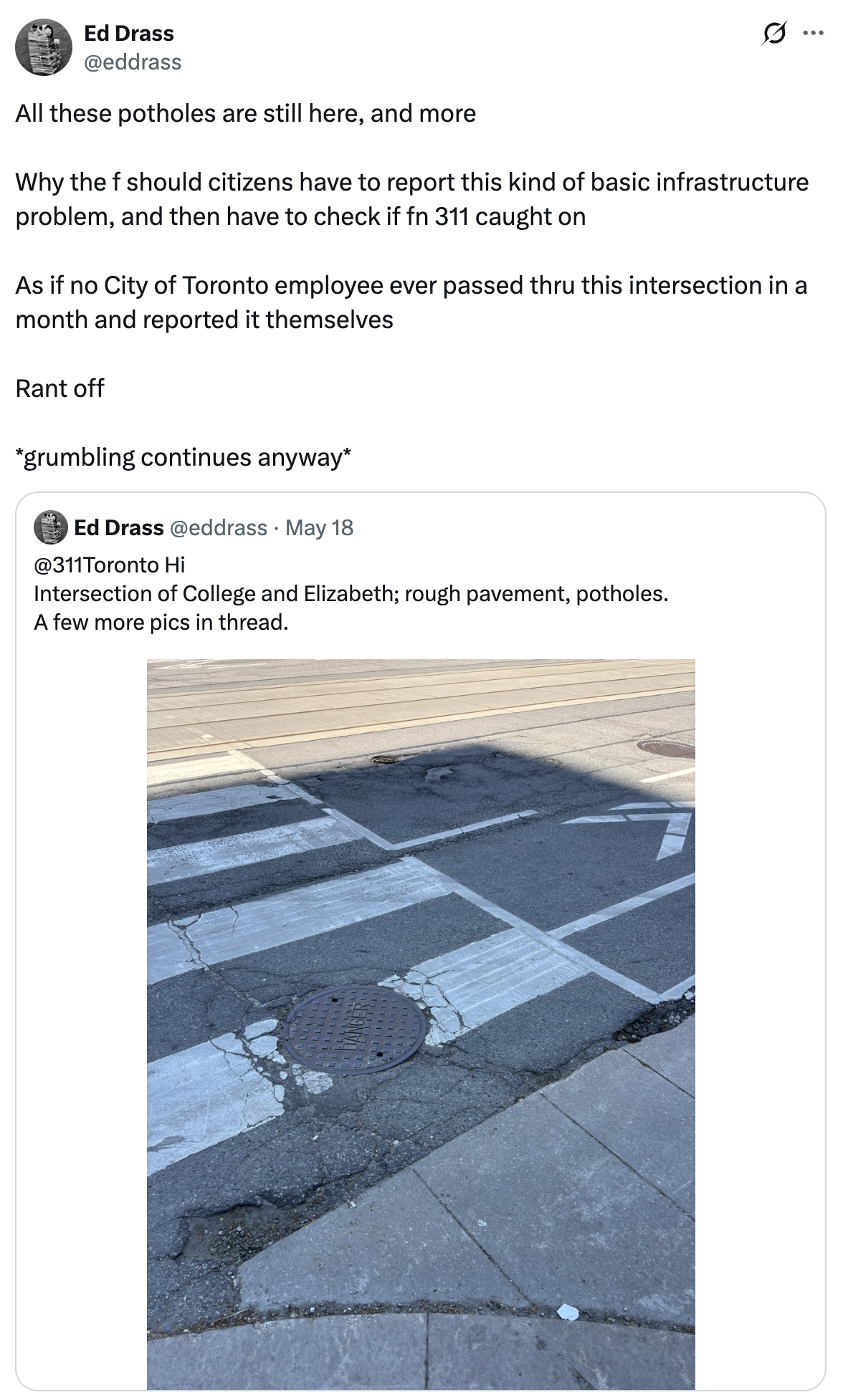
A Toronto resident named Ed Drass tagged 311 on May 18 about the intersection of College and Elizabeth. Rough pavement, potholes, and a manhole cover sitting in the middle of the crosswalk with the word DANGER stamped right on it. He attached the photos. He did everything the system asks a resident to do.
Weeks later he posted again. All these potholes are still here, and more.
Then he asked the question that the complaint was hiding underneath. Why should a resident have to report this kind of basic infrastructure problem, and then babysit 311 to see if it caught on, as if no City of Toronto employee ever passed through that intersection in a month and reported it themselves.
That question deserves a straight answer, not a sales pitch. So here it is.
He’s right. It should not fall on residents to be the city’s eyes. People who are paid to maintain that road drove through that crosswalk for a month, past a cover that says DANGER, and the system still sat there waiting on a citizen with a phone. The noticing was supposed to be somebody’s job. On that intersection, it was nobody’s.
But here is the part that turns the anger into something useful. The city fixes what gets reported, and almost nothing gets reported, and even what does get reported lands in a pile of channels that never tell you what happened. That is the machine Ed was fighting, and it is worth seeing it clearly.
Five doors, one silence
Ed tagged 311 on Twitter. He could have called the line, filled out the web form, opened the app, or sent an email. Five different doors into the same building. Each one is its own inbox, with its own format, and none of them closes the loop. You knock, the door opens, and then nothing. No “we see it.” No “it’s scheduled.” No “it’s done.” You are left checking back yourself, which is exactly the babysitting Ed refused to keep doing.
That is the real failure, and it has nothing to do with the crews. The people who patch the road show up and do good work. The gap is that the moment you care about, the one where someone tells you that you were heard, never reaches you. When that moment never comes often enough, you learn the lesson the system is teaching: reporting is pointless. So next time you swerve around the crack and say nothing. The city ends up fixing only what the most stubborn residents chase the hardest.
What I built, and what it actually does
I lived inside that silence until late February. I would report something and lose the thread. So I built SolveTO, not to replace 311 and not to do the city’s job for it, but to give that effort one door instead of five and to make sure it stays visible after you knock.
I will be precise about what that has and has not done, because Ed deserves precision. I do not control when a pothole gets filled. No app does. But more issues are getting reported, and getting fixed, faster and in higher volume, because the door is no longer five minutes of friction. Over 850 reports have come through since March, across eleven departments and two cities. The page that tracks a report is cleaner and easier to follow than what most residents are used to. The reports still reach the city’s systems, because the goal was never to route around the city. It was to stop residents from shouting into five different voids.
The one thing that actually moves a fix
Here is what I have watched work, and it is the answer to Ed’s “I shouldn’t have to chase this.” You are right that you shouldn’t. But while the burden is still on you, do not spend it the way the system wants you to, alone and quiet.
Report in volume, and reach your ward councillor in volume. One report is a complaint, and a complaint is easy to lose. A hundred reports on the same broken street is a pattern, and a pattern is something the city has to answer for. That is how the effort residents are forced to spend stops disappearing and starts becoming pressure. Pressure is the only thing that has ever turned into accountability.
Ed should not have to file a report to get a dangerous crosswalk fixed. Neither should you. Until that changes, the system will keep fixing what it hears, so the move is to make it impossible not to hear you. The only thing louder than one frustrated resident is a whole street of them pointing at the same crack.